
The Price of Silence
Reputation can have measurable economic consequences, but the strongest causal evidence comes from specific markets. Here’s what the research supports — and where generalization stops.
Eight months ago, someone left a two-star review. It described a scheduling mix-up, a long wait, and a rushed conversation. Nobody from the business ever replied. The review is still the fourth result a prospective customer sees today — sitting there, unanswered, quietly doing its work every single time someone considers calling.
Harvard Business School economist Michael Luca studied independent restaurants in Seattle and found that a one-star increase in Yelp rating was associated with a 5% to 9% increase in revenue. That result should not be mechanically applied to every industry, but it is strong evidence that visible reputation can affect demand in a well-studied local market.
The Wall Before the Door
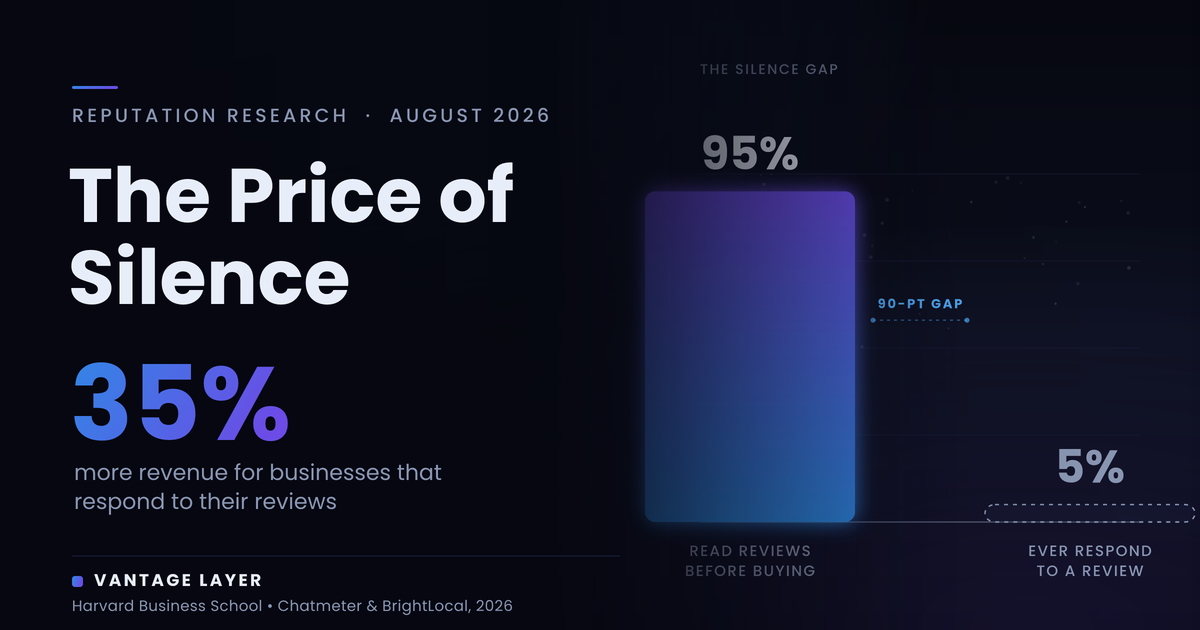
Reviews don't just influence a purchase decision — for most businesses, they decide whether a customer ever reaches the decision stage at all. Chatmeter's 2026 research found that 92% of consumers require at least a four-star average before they'll even consider a local business, and separate research puts the number who are actively deterred by one- or two-star reviews at 86%. Ninety-five percent of consumers read reviews before buying anything.
Silence Is a Choice
Here's the part most owners don't realize: responding to reviews is one of the highest-leverage, lowest-cost actions in local marketing — and almost nobody does it. Industry research puts the share of businesses that respond to reviews at all at roughly 5%. Meanwhile, 53% of customers expect a response to a negative review within a week, and 87% of businesses fail to meet that expectation.
The businesses that do respond aren't just avoiding damage — they're actively winning more revenue. Businesses that respond to at least a quarter of their reviews earn about 35% more revenue on average, and responding to even a single review correlates with a measurable revenue lift on its own.
Ten Minutes a Week
The fix is smaller than the problem suggests. Research on review response behavior found that spending as little as ten minutes a week publicly responding to reviews reduces the reputational impact of negative feedback by roughly 70%. Consumers are also considerably more likely to revise a review upward when a business responds with a genuine, personalized message within a day of it being posted.
This isn't about chasing a perfect five-star average — real, engaged businesses rarely have one, and consumers have learned to trust a rating with visible responses over a suspiciously spotless one. It's about making sure silence is never the business's answer to a customer who took the time to say something.
The businesses quietly pulling ahead in every one of these categories aren't necessarily better at the work. They're simply the ones who stopped treating reviews as something that happens to them, and started treating them as a conversation worth showing up for.
What are your reviews actually saying about you?
We'll show you exactly how your review profile compares, what's costing you conversions, and what to fix first.
Book Your Signal Audit Call →← Back to Vantage Layer