
The Five-Minute Window
Why response speed materially changes the odds of reaching and qualifying a new lead.
A homeowner with a burst pipe opens three tabs at 8:47 PM on a Tuesday and requests quotes from three businesses within two minutes. The first useful response can gain a major advantage while the buyer’s intent is still active—but price, trust, availability, and fit still influence who gets the job.
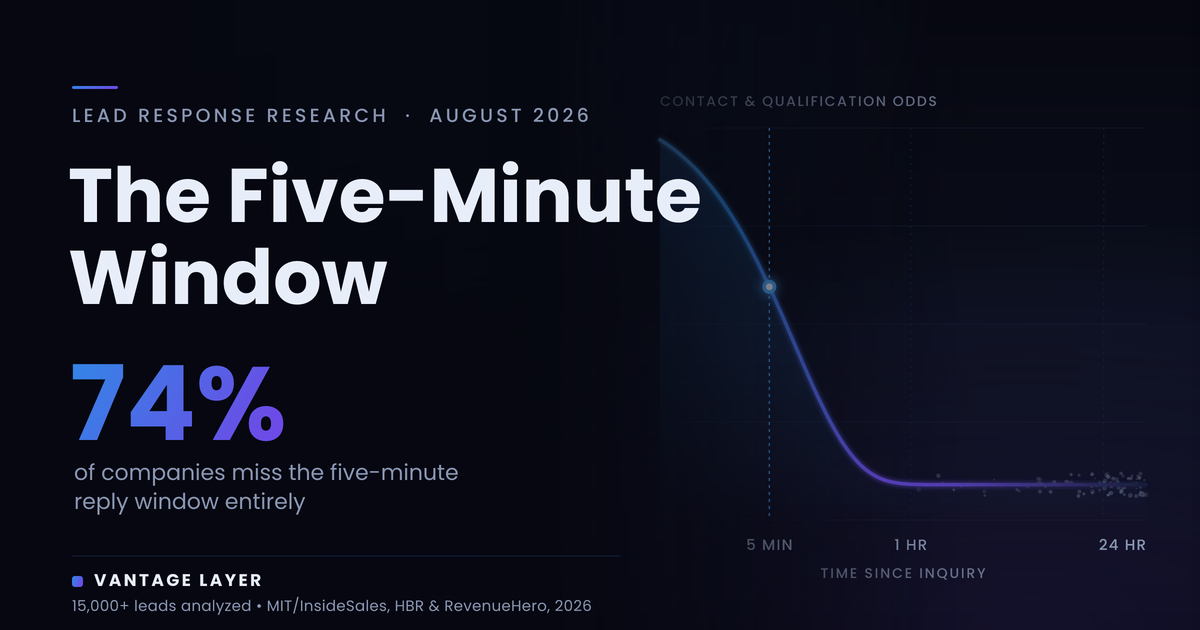
This is not hypothetical. A landmark lead-response study tracked more than 15,000 leads and 100,000 call attempts and found that contact and qualification odds fall sharply as response time lengthens. The evidence supports speed as an important conversion variable—not a guarantee that the first response always wins.
The Uncomfortable Average
Here's the gap between what wins and what actually happens. Multiple 2025–2026 studies put the average B2B response time at around 47 hours — nearly two full days. A RevenueHero study of more than 1,000 companies found that 63% never responded to a web form submission at all. A separate Harvard Business Review audit of 2,241 U.S. companies found 23% never responded to a lead, period.
Different studies land on different exact multipliers—some cite qualification odds rising more than twentyfold with an immediate response, while others describe conversion lifts of several hundred percent for near-instant contact. Magnitudes vary by industry and study design. The direction does not.
What Happens After You Miss the Window
Once a lead goes unanswered, the odds don't decline gently — they fall off a cliff. Call-tracking data shows 80% of inbound callers won't leave a voicemail, and 85% won't call back at all if they don't reach someone on the first attempt. A 2026 benchmark study across 573 companies found that 74% miss the five-minute response window entirely — even among leaders who say they know better: over a third call a five-minute response essential, yet more than a third of that same group admit they don't meet their own standard.
The Window Is Even Shorter in Some Industries
Speed matters across many categories, but the window can be tighter when several providers compete for the same moment of intent. Insurance shoppers may request multiple quotes at once; real-estate interest is often strongest at the moment of inquiry; and home-service businesses paying for leads can lose opportunities when response is delayed. The practical point is not that speed guarantees the sale—it is that slow response creates avoidable conversion risk.
Why Most Businesses Can't Keep Up — and What Actually Works
The honest reason most businesses miss the window isn't a lack of urgency. It's that the owner is on a job, in a consultation, or asleep when the lead comes in — and no single person can be available every hour a buyer might reach out. Automated instant acknowledgment closes that gap without replacing the human relationship: the pattern that performs best is immediate response followed by real human follow-up, not one or the other. Consumers have adjusted to this — most now expect a reply within minutes for any sales inquiry, and a majority who interact with an automated first response still want a person in the conversation shortly after.
None of this is about replacing your team. It's about making sure the moment a buyer raises their hand, someone — or something — is there before they move on to the next name on their list.
How fast does your business actually respond?
Most owners are surprised by their own numbers. We'll show you exactly where your response time stands — and what it's costing you.
Book Your Signal Audit Call →← Back to Vantage Layer